From the Series on Foreign Policy and International Relations
ELSHAN MISIR OGLU NASIBOV
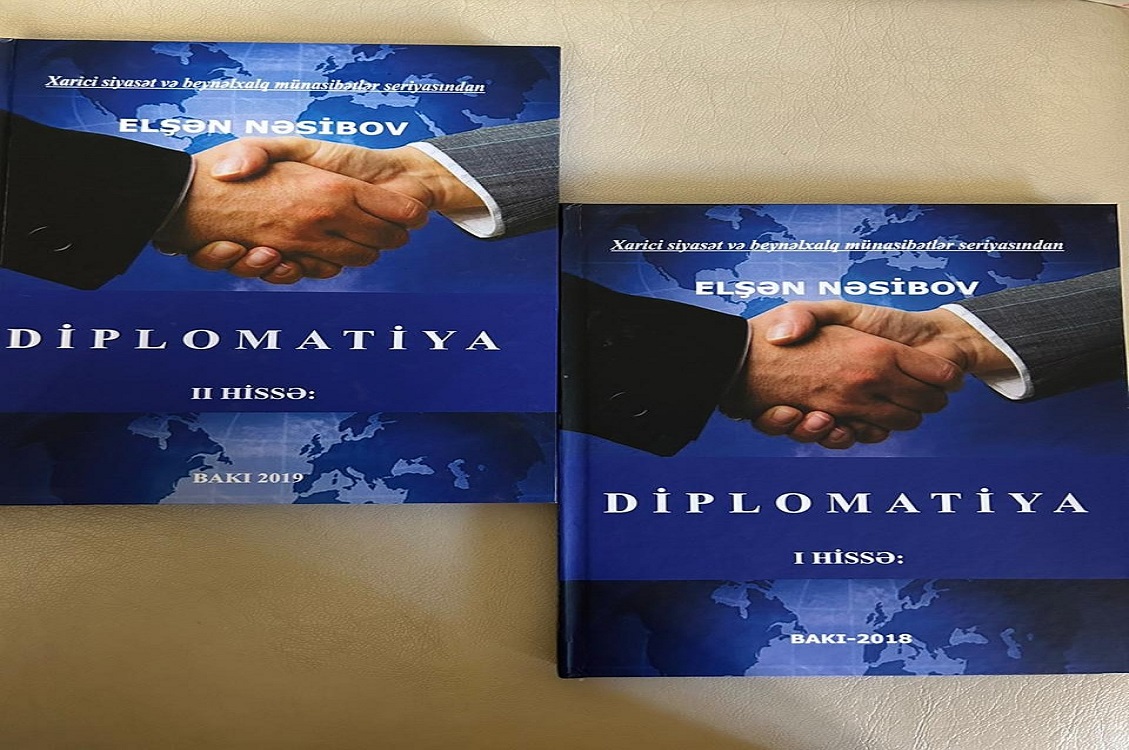
DIPLOMACY
PART I:
Translated by Zamin Akhundov
The work defines the concept of diplomacy and covers its content in a broad sense. It reflects the multifaceted structure of the constituent elements. Diplomacy is considered as a set of foreign policy acts of the state and as a system in this regard. The work opens the concept of diplomacy with theoretical parameters and reflects the general - broad and limited - specific meaning of the concept. The goals and objectives, targets and intentions of diplomacy, as well as its certainty and purpose, are explained. The philosophical meaning of the concept of diplomacy is clarified. The uncertainty of the concept is replaced by certainty and a structure of thought and a construction of thought is established for itscomprehensive understanding.
Thanks to the explanations, the conceptuality of diplomacy is reflected. Diplomacy is defined as a unified form of foreign policy. The work involves the stages, areas, and, in this regard, the types and forms of diplomacy as the object of analysis. It also reflects the mutual relations of this profession, which belongs to statehood, foreign policy ideology, and humanity, with the branches of power. The book is recommended for colleagues in the diplomatic profession and students studying for this profession, as well as specialists engaged in scientific activities.
CONTENTS:
CHAPTER I:
CONCEPTUAL FOUNDATIONS OF FOREIGN POLICY ........................... 5
What is the concept of foreign policy ................................................................... 5
What is foreign policy strategy ........................................................................... ..11
What is foreign policy doctrine ........................................................................... ..14
CHAPTER II:
FUNDAMENTALS OF DIPLOMACY ............................................................17
What is diplomacy .............................................................................................. 17
Definition of diplomacy ...................................................................................... 25
Some summarized thoughts on the definition of diplomacy ............................... 52
Anthology of additional thoughts on the definition of diplomacy ...................... 63
Philosophy of diplomacy ........................................ …………………………….74
Geopolitical diplomacy ........................................................................................ 81
Economic diplomacy ............................................................................................ 86
Geoeconomic diplomacy ....................................................................................... 92
Global diplomacy and international diplomacy .................................................... 94
National diplomacy ............................... ………………………………………..102
What is alliance diplomacy................................................................................... 106
4 CHAPTER III:
THE ESSENCE OF DIPLOMACY....................................................................111
Goals and tasks of diplomacy ............................................................................ 111
Goals and tasks of diplomacy (at the stage of higher diplomacy)………………114
Goals and tasks of central-stage diplomacy .........................................................117
Goals and tasks of lower-stage diplomacy ......................................................... 122
Goals and tasks of lower-stage diplomacy (against the background of individual representation in international institutionalized diplomacy) ............................... 126
Goals and tasks of diplomacy (against the background of the special mission of lower-stage diplomacy .........................................................................................130
Goals and tasks of institutionalized international diplomacy ........................... 134
Some generalized ideas about the goals and tasks of diplomacy anthology .....138
The relationship of diplomacy with the branches of government ...................... 146
CHAPTER I:
CONCEPTUAL FOUNDATIONS OF FOREIGN POLICY
What is the concept of foreign policy.
The conceptual foundations of foreign policy are formed by all the parameters of foreign policy in the relevant areas - the sum, collection of fundamental acts. In which the goals of action and conceptual, branched intentions of the state are concentrated. The conceptuality of foreign policy forms the fundamental principles of international relations.
It provides the theoretical and practical richness of international relations, enriching its level. There formability of foreign policy and the properties of the replacement development of acts form the conditionality and unity of concepts in space and time.
The realities and requirements of international relations form the conceptual elements of foreign policy that change and renew in the superstructure.
The concept of the concept is general in terms of the properties of its internal constituent elements and reflects the constituent elements of strategic meanings and linear trajectories (chains of expressions) in itself, including encompassing, exhausting, and integrating, as well as centralizing and spreading forms.
The criterion of the concept combines the plural criteria and constituent meanings of the concept, notion. The concept expresses the tactical steps of the strategy, the branching trajectory. The conceptual foundations of the concept are formed by the perception of the areas in which it is applied and their imprinting in the minds. Conceptuality, as a property, expresses unity, directional foundations, linear intentions, and goals. The concept is a theoretical set consisting of a series of views on the future, proceeding from the current flow of time, while sequentially completing the past.
The concept combines programs and action plans in this direction in character. The concept is a compact, complete platform consisting of a network of plans and forecasts, as well as a collection of documents, provisions, norms, and executive rules that have models and formulas. Theoretical ideas can be analyzed in concepts, and final statements can be reflected. These final statements also reveal and prove the essence.
The concept combines the aggregate form of state legislation, the system of primary legal norms in public administration. It gives a legal flow and direction to politics. It subjects politics to rules, measures and norms in space and time. The concept forms the sphere of socio-political, social relations and connections between the state and citizens, as well as between the state and non-citizens. It creates a system of appropriate relations and relationships between people and political authorities.
The concept is the main line that unites other concepts. The concept, while expressing the basic and leading documents, combines coordinating tactical norms. The concept as a whole systematically contains basic provisions and auxiliary, comprehensive norms and rules, and binding expressions. Binding expressions form the conditionality of the concept. They connect the basic provisions and norms to each other and create a comprehensive plane, shades of colors. The composition of the concept and concept are complexities consisting of simplicities.
These complexities carry a comprehensive content. Complexities combine goals and objectives, and targets. Tactical rules also arise from general principles, and processes are formed. Complexities reflect the construction and binding nature of the concept, and consequently, the holistic content. In politics and public administration, in the system of power, the concept acquires a diversified and pyramidal content.
At the upper stage (at the highest level of state power), higher and general comprehensive concepts are adopted, and concepts are also diversified with tactical (framework, limited scope) documents. Strategies and doctrines perform the function of structural centralization of the concept. They cover the content. Although the concept of policy sounds specific, it carries a wide spectrum of state activity. Policy systematizes the legal foundations of state policy.
It expresses the foundations of management and regulation. The concept of management forms a systematic and comprehensive network of state regulation. The concept of policy reflects the depth and breadth of coverage of the political plane. It carries the movement of political elements in time and space, and in this regard, the sequential goals and objectives of policy subjects are in accordance with the conditions.
The concept of policy expresses the concentrated aggregate unity of political ideas. The strategic and tactical essence of policy, the basic goals and objectives of policy, are reflected in the concept of policy in a general, theoretical way. The concept represents and presents the basics of strategy and doctrine. Along with strategy and doctrine, tactical steps, policy plans, and programs constitute the composition of policy concepts expressed and realized over time. From the concepts, derivative framework concepts and strategies are formed in individual areas of policy. Concepts cover general policy, as well as generalized, distributed tactical policy and management in areas.
Thus, they create an organic strategic connection between the state and the person, forming unity. The concepts reflect the basic flow of policy and the basic goals and objectives of the state in the form of provisions. The concept of policy and management collects the ideology of statehood in itself. It systematizes the goals and objectives for ideology. Concepts consist of theoretical provisions expressed in time and space. Concepts have a general framework and a limited (sectoral) framework in the areas covered by the policy. The contents complement each other individually and broadly.
Policy concepts can be reformed and changed depending on the space and conditions and the emerging realities. Along with the internal policy of the state, foreign policy also expresses the steps, goals and objectives, targets, and intentions of the management concept. It combines and complements foreign policy with a system of internal acts. The foreign policy concept reveals the essence of the diplomacy concept. Because the diplomacy concept expresses the aggregate foreign policy acts of the state. It can gather the comprehensive foundations of the state's participation in the international world with its foreign policy.
The diplomacy concept, in addition to being an aggregate state of foreign policy, can also be expressed separately as a set of strategic and tactical acts that arise from it and complement it. The baseline of diplomacy is reflected in the foreign policy concept. The geopolitical goals of the country are expressed in strategic terms. The diplomacy concept consists of steps to achieve the foreign policy concept and includes relevant and specific events.
The diplomacy concept has the function of consistently fulfilling the provisions of the foreign policy concept. Here, the relevant steps are expressed and summarized in a complex to complete the foreign policy concept. Diplomacy and foreign policy concepts are prepared in accordance with the legislation of the state and the international legal system. The principles of international law are expressed as basic principles in conventions. The necessary foundations of the state's foreign policy steps constitute the main line of the concepts. The foreign policy concept shows the paths and progress in a general and strategic form. Sidelines, derivatives, and networks reflect tactics.
What is a foreign policy concept
There are sections of the policy concept, a comprehensive, cumulative document, and in this regard, the state management strategy, on the internal and external levels. The foreign policy concept can be considered as a separate section of the general state concept (for example, related to security and development issues, related to visions for the future).
It can also be formulated in a completely separate way - by dividing it into strategies and doctrines. The concept can be structurally organized into analytical and guiding sections. In the analytical section, the reasons can become the object of extensive analysis and be systematized.
In the analytical section, the current state of foreign policy, the international situation on a regional and global scale and level, the goals of foreign policy, the areas covered, the time factor for achieving the goal in foreign policy, the future directions of foreign policy, the tasks set, and the objectives can be presented in a series. The concept can explain the past achievements of foreign policy, the successes achieved, and the international progress, as well as the basics of steps in accordance with the international situation. Concepts themselves can be derived from strategies and revealed, clarified provisions arising from internal and external necessity. Development concepts respond to the requirements and challenges of the era. Provisions that are ahead of time and direct the course of future events can be reflected in concepts.
Foreign policy concepts can be adopted for the following purposes:
- to prove the state's activity as an actor in international relations;
- to introduce the state as a reliable collaborator and reliable partner; - to benefit foreign policy; from international relations - in order to obtain international guarantees for the state as an actor;
- in order to ensure the comprehensive coordination of the country's foreign policy course with domestic policy;
- in order to comprehensively present the compliance of the country's foreign policy course with international law;
- in order to systematize the generalized theoretical provisions of the country's foreign policy course;
- in order to generalize the country's development needs in accordance with the course of events;
- in order to ensure the consistent implementation of foreign policy programs and plans;
- in order to ensure the country's full participation in the sphere of international relations through foreign policy;
- in order to ensure the comprehensive direction of foreign policy;
- in order to comprehensively solve the problems of foreign policy and international relations, to take a comprehensive approach to issues;
-to express the humanitarian content of foreign policy;
-to systematize the basic principles of foreign policy;
-to unite the power and potential of foreign policy;
-to clearly justify and demonstrate the foundations of foreign policy;
-to comprehensively explain the content and essence of foreign policy;
- to complicate the strategic essence of foreign policy and open up areas, reveal them, and form a system of goals; - to complicate the areas covered by foreign policy acts;
-to systematize the goals and objectives of diplomacy;
-to systematize the future diplomatic system;
- to ensure the networking of successes and achievements; - to ensure the structuring of diplomatic activity by spatial and temporal factors and criteria;
-to organize and present transparent and open, as well as confident, diplomacy;
- to prove the importance of diplomacy in international relations; for
- in order to prove the design and organization of diplomatic activity in accordance with international conventions and other documents, etc.
What is a foreign policy strategy
The concept of strategy, its expression in terms of content, is understood as a plan, a future program, steps to be taken. It is considered a set of actions, lines of action and networks, directions, distinguished paths. Strategy is considered a component of the concept and is more diversified and deep-rooted, derivatively based. Strategy, as it were, confirms the concept in areas and guarantees it with its tactical steps. Strategy serves to deepen the concept.
If the provisions of the concept carry general meanings and cover general steps, then the strategy, branching out from the concept, further improves it and based on specific provisions, sectoral systems. Strategy diversifies the concept in sections. Strategy is the content and form, the essence, consisting of a set of advanced and tactical steps.
Strategy is of a guaranteed and defensive nature in terms of content. It also contains the essence of mobilization. Strategy is a conceptual content that involves the concentration and cumulative use of existing potential. During the implementation of the strategy, goals and tasks are collected in areas and lines, and targets are determined and systematized. Consecutive actions and purposeful steps are covered. Policy strategy is a strategy and concept of state management in the domestic and foreign spheres.
The conceptual content of the policy generates and gives rise to the strategy. Strategy systematizes general goals with specific steps. Creates the base and surrounding structure of the provisions. The strategy of the policy consists in the fact that the appropriate steps for the acts are concentrated. The provisions are systematic, on a conditional basis, in a sectoral and compact form, as well as in a comprehensive manner. Foreign policy strategy is the planned and programmatic nature of the state's foreign policy acts.
-It is a mobilizing essence for the elements that foreign policy should achieve. Foreign policy strategy is a systematic and structured form that includes the linear goals of foreign policy. Foreign policy strategy is a basic planned structural form consisting of a system of diplomatic functions as a set of acts.
It is a set of planned acts that direct the instruments of foreign policy towards its goals. The concept and strategy of foreign policy is a system that ensures the consistency and purposefulness of foreign policy and diplomacy, which is its manifestation. Foreign policy strategy is a set of acts related to foreign policy, a set of legislation. Here, the main laws and laws, the programs and concepts of the head of state related to foreign policy, other decisions (decrees and orders), and international conventions to which the country has joined are of strategic importance as important documents.
Foreign policy strategy is a set of directions that direct the flow of foreign policy, taking advantage of the current and future international situation and conditions. Foreign policy strategy is a set consisting of a system of gains and losses in this area. Foreign policy strategy is a model applied in this area. Strategy carries victorious diplomacy in its content. Strategy is a complex of documents serving geopolitical diplomacy. The main goals of foreign policy strategy are to maintain the country's respect in the foreign sphere and make it strong, as well as to form an effective position using domestic and international resources.
Foreign policy strategy is adopted with the following goals:
- in order to mobilize appropriate elements to determine the basic principles of foreign policy;
- in order to determine and improve the set of foreign acts of the country's policy concept;
- in order to systematize and structure the directions and goals of the foreign policy course;
- in order to systematize the tasks and functions of foreign policy;
- to determine the principled unity of foreign policy with international relations;
- to determine the analogous functions of foreign policy and international relations;
-to reveal and declare the state's targeted participation in international relations;
- to summarize the directions of the country's regional and non-regional relations;
-to express the plan and program essence of foreign policy;
- to determine the strategy at the international level;
- to organize the country's defense in the international world in a guaranteed way;
- to form a solidly based foreign policy course for the country;
- to form the foreign policy doctrine;
- to harmonize foreign policy and security doctrines;
- to determine a single policy of the country;
- to benefit from the values of the international world;
- to determine the appropriate steps in advance at the international level;
- in order to determine winning and profitable diplomacy;
- in order to apply preventive diplomacy, etc.
What is foreign policy doctrine
Doctrine means a system of worldviews reflecting teaching, scientific, religious, and philosophical views, theories, laws, and philosophical canons (that is, criteria, measurements, political and theoretical principles).
Doctrine is a conceptual expression, an understanding. Doctrine reflects the principles of law. The legal system is embodied in doctrines. In doctrines, principle conditions, and systems of ideas, ideas embody their expression. The legal and legislative principles, foundations, and criteria of the state, and the principles and standards of state policy are expressed in doctrines. The state declares its policy. It explains the principles and content of acts. The system of acts of the state, the set of provisions, is expressed in doctrines, a system of theories. The current and future intentions of the state are embodied in declarations and legal teachings with a clear content, as well as the political goals of the state, which are embodied in teachings, a collection of documents.
This collective concept has a networked nature, and its content is defined. Baselines are defined. Foreign policy doctrine is a concept consisting of foreign policy laws, structural regulations, charters and teachings, and views. The basics of the state's behavior in certain places over time are reflected. Foreign policy doctrines express issues of security, guarantees, and security. Foreign policy doctrine forms the basic course of foreign policy.
The strategic meaning and strategic essence of foreign policy are expressed precisely in doctrines. Foreign policy doctrine expresses more geopolitical parameters. Foreign policy theories and the basic principles of foreign policy are expressed in doctrines in unity. Doctrines are important as fundamental geopolitical documents. The state's interests in the regions, political concepts, and economic and military strategies are presented precisely in the form of doctrines.
Doctrines can be characterized as comprehensive strategic documents that declare the comprehensive foundations of foreign policy in a comprehensive form. Doctrines make the country's interests defensive. Systematize strategic attack and defense points and directions. Doctrines are important as a law that determines the sphere of influence of foreign policy. They become the object and subject of public and political discussion in the legislative body of the state. Doctrines, as legal documents, acquire strategic-conceptual meanings. They contain a set of the main acts of the state in the field of foreign policy.
Doctrines are adopted for the following purposes:
- in order to personalize and universalize foreign policy concepts;
- in order to complete and strategically improve foreign policy concepts;
bases - through active participation in international relations with foreign policy strategies;
- in order to strengthen in the field of international relations with foreign policy acts;
- in order to become an associate member of the field of international relations with foreign policy acts;
- to strengthen self-defense in the international arena through foreign policy acts;
-to strengthen self-defense in the international arena by declaring a system of foreign policy acts;
-to consolidate the potential of foreign policy;
-to consolidate foreign policy doctrines, theories, and views;
-to systematize the country's foreign geopolitical sphere and position;
-to systematize the country's geopolitical spheres of influence;
-to reasonably declare the country's internal strength and potential abroad;
-to declare the country's principles of cooperation and partnership in the international arena;
-to declare the country's ways of protecting itself from threats through foreign policy;
- to combine and apply internal and external resources through foreign policy;
-to declare the country's code of conduct in international relations;
-to define and declare the country's principles of conduct in international tensions;
- in order to present the principles of foreign policy;
- in order to form a successful and strong, etc., in order to form a strong diplomacy, etc.
CHAPTER II:
FUNDAMENTALS OF DIPLOMACY
What is diplomacy?
Diplomacy is a general concept, a broad expression, rich in constituent elements, multi-structural and multifunctional in form, and is the legal and political composition of the state's foreign policy activity, its realized embodiment. The legal and political composition allows the concept of diplomacy to carry the concept of statehood, the ideas of statehood in the international sphere. Because foreign policy is a set of acts that the state carries out and proves in the international world. Diplomacy is a positive, imperative, and decisive type of activity that not only takes the state beyond its borders but also protects and strengthens state borders and instills and demands respect for state borders.
Diplomacy is a tool that generalizes multilateral foreign policy acts. In this respect, the mechanism plays the role of a functional machine and apparatus in foreign policy.
Diplomacy is a profession and field of activity that includes acts of foreign policy (creating new acts by executing acts). An act is an event with a certain beginning and end, the emergence of new elements in space, as well as the displacement of elements in space, the transition of a passive environment to an active environment, and the process of manifestation and realization. A political act is a certain spatial movement, an event that reflects the existence and development of the state. From this point of view, diplomacy is an economic, political, social, military, and legal-cultural phenomenon that includes a set of active events. An act is also a normative-legal document that reflects the policy of the state.
International acts are bilateral and multilateral, general and framework documents drawn up and adopted by states, international treaties, correspondence, and other documents. Are agreements diplomacy? As a set of acts, it is a means of influence. The influence of each state is calculated on the internal audience (society). Influence is determined by the power of influence. Its effects are determined by the potential of the source.
If the state provides its internal elements at a normal and high level, then that state is strong and has great potential. The economic income of the state plays the role of a criterion, a benchmark reflecting its internal power. The power of the state determines the stable and dynamic development of the state and society. When the state has a lot of funds, it becomes easier to manage society. Society achieves its happiness through the power of the state
The high turnover of society's funds also contributes to the state's strengthening. The power of the state also necessitates and conditions the strengthening of its diplomacy. Internal power enriches the trajectories of external action and expands its sphere and scope. A strongly secured society proves a rich state, which in turn reflects the existence of effective diplomacy. Another direction that ensures the prestige of the state is the international level. The wealth of the international level is the basic food of the state. International energy feeds the state's internal capabilities and strengthens its foreign actions.
The strength of the state's foreign policy increases its sphere of action and geopolitical influence. In this regard, the state has graduated spheres of influence at the international level. The state influences the international world with its economic, cultural, and military elements. The background of international competition ensures the mutual mobilization of the capabilities of states and accelerates actions. The thickness of the trajectory of acts at the international level increases the strength of foreign policy. The internal prestige of the state can also be strengthened by its external acts and actions. Similarly, the internal potential of the state increases its influence abroad. Here, economic elements and cultural factors (for example, the factor of language and religion) play an important role.
The ultimate goal of diplomacy is to create a linear connection between these two directions (internal and external directions). The ultimate goal of diplomacy is to attract sufficient funds for the happy and prosperous life of society, which is the source of the state. Here, the goals and duties of diplomacy are combined. Consistency and unity are formed between duties and goals. All are united. States in the conditions of information exchange. The struggle of states also occurs due to the dissemination of information about events. With the dissemination and declaration of information, the mutual positions of states become clear.
Thanks to information, the style and direction of relations and connections can be determined. The flow of information, mutual exchange, and transitivity in themselves form a network of international relations and international positions. Here, one of the official policy tools that carry information is the field of diplomacy.
Diplomacy ensures the dissemination of information by visible and absentee, direct and indirect means. Diplomacy acts as a leading and connecting tool that carries information with political acts in the international world. Diplomacy is the field and means of embassy and representation, public and political agency that conveys words and news, fulfills requests and appeals, takes mitigating positions in the international world, and performs acts.
Diplomacy is the basic field in which the state presents a power of attorney in the field of foreign policy and justifies its foreign policy activities. In diplomacy, the head of state (with constitutional authority), heads of government (with the powers granted by the head of state, with the powers provided by the legislation), heads of central executive power, and diplomatic representatives, by proxy of the state and the people, accumulate in themselves the qualities of the party granting the power of attorney (the people, the state), and carry its elements. In this regard, diplomacy is important as a cultural, spiritual, ethical and aesthetic professional field. The means that make foreign policy necessary also make diplomacy necessary.
Because diplomacy, as a field of activity, consists of tactical moves in foreign policy and international relations, implemented acts, and, in this respect, cultural, economic, political, and legal norms and rules. The use of planetary resources with uniform rules, common coefficients, and the same and appropriate measures and criteria, in a certain quantity and quality, belongs to the goals and tasks of humanity. In the conditions of modern globalization, states are faced with the necessity of living together. The rapid development of information technologies is bringing the lives of the peoples of the world closer to each other. The technological status of the world requires the strengthening of foreign policy and the acceleration of relations against the background of international relations. Today, it is impossible to live in isolation from the international world.
The processes of unification of the peoples of the world have accelerated. In this regard, states are paying special attention to their foreign policies. They view their foreign policies as a means of nourishing their internal systems. On the other hand, the desire of great powers to divide the world and create new control mechanisms in an open environment necessitates the formation of a new type of diplomacy. In this regard, active and open diplomacy, quiet and, in this sense "dumb" and passive, as well as covert types of diplomacy are emerging. The state's involvement in international relations makes diplomacy necessary. The purpose of diplomacy is to ensure and protect the interests of states and the organizations they create in the processes of forming the world order.
Diplomacy is a professional field of political, legal, economic, cultural, and military nature that belongs to the state (the main subjects of international relations) and organizations that specialize, distinguish, group, create classifications, and quantitatively rank its areas of activity, as well as divide interests into areas (derivative subjects of international relations, international relations, and international law). Diplomacy is a tactical-executive field, a tool of security and defense strategy.
Diplomacy brings state policy, state activities, and acts from the inside out and connects them with other state activities. Thus, the political ties and policy directions of states are connected by wires and form the same linearity and completeness. Diplomacy assumes the task of fulfilling the constitutional obligation, which is the fundamental law of the state, and bases the state's policy in the field of foreign policy on legal norms and rules.
It determines the dimensions and limits of foreign policy, as well as carries out the actions of subjects and parties with appropriate dimensions and limits. In this direction, diplomacy is a real and practical field of activity that determines the scope and sphere of application of political acts and draws actions and lines.
Diplomacy is the basis of political activity as a determining and executive tool in international relations and contains legal principles, norms, and rules. Diplomacy creates the canons of international and universal philosophy with the participation of international actors and serves idealism. It glorifies global peace building. In this direction, the character of humanitarian diplomacy is formed.
Diplomacy as a profession determines and determines the boundaries of law in foreign policy. Diplomacy is a cultural, social, legal, and military formality, and also, according to its rights and powers, as well as according to the form of implementation of this professional field, it is possible to divide it into types and varieties. For example, in diplomacy, direct and indirect policy, bilateral and multilateral negotiation format, meeting platform, mediation mission, conciliation function, fact-finding, level of representation, term of representation and mediation, term of office, and temporary and fixed-term character, it is possible to distinguish types and types of diplomatic activity and the diplomatic field as a profession (as a field of employment).
For instance, diplomacy can be broken down into three types based on the level of power and rights of those involved: higher (between heads of state and heads of government), middle (at the level of central executive power), and local (diplomatic representation in countries and organizations).
Here, bindingness can be divided into stages from diplomatic representation to the level of heads of state and determination from the highest level to the lowest level. Initiative and idea generation are distinguished in terms of. Diplomacy is a process of separating, revealing, and determining. It examines the details of events. It determines the causes of occurrence. Not only that, but it takes preventive measures and eliminates tensions. Diplomacy collects information about events in destination countries and conveys it to the host country. It collects, analyzes, and shares conclusions about the daily processes taking place in the destination country.
In this respect, it reveals the mutual relations of states in the international sphere. Diplomacy is a field of activity that carries the functions of representation and presentation in terms of form and content. Diplomacy is a field of mediation, unification, coordination, and regulation in terms of functional nature. At the same time, it is a centralizing and peripherally disseminating tool.
Diplomatic activity is an apparatus, a structured mechanism as a whole. This apparatus "walks" in the international world, in the sphere. Diplomacy informs the international community about the external and internal situation of its country, as well as its foreign and domestic policy. Diplomacy is a field of activity that determines the unification and alliance of states on a regional scale and on a non-regional basis.
In this respect, it is a tool that determines the common interests, goals, and intentions of states in the international world. Diplomacy is an ethical and aesthetic professional field in a positive sense. It is important on the grounds of moral, guaranteeing obligations and protective responsibility. The goals of humanistic diplomacy are peace, tranquility, reconciliation and dynamic development. Steps in this direction are taken fairly. It is based on maintaining balance. The interests of the parties are managed in a balanced manner. Funds are delivered to the parties with a fair share. Each state is allowed to participate in the sphere of international relations according to its strength and capabilities. The charters of international organizations are followed.
Positive diplomacy is an idea and embodies ideals. In positive diplomacy, relations between large and small states, as well as states with a relatively medium power, are based on sound principles and sound ideas. Mutual concessions and compromises, soft agreements, are applied. In the center (at the basis of service activities), instead of national extreme ego, the factor of human interest stands.
Regardless of the number of people and the size of the country, all people are viewed as cultural values. The world is viewed as a whole sphere of interest, a place of common interest. Peoples are viewed as an integral part of world civilization. The cultural and political spirit of all peoples is respected. Positive diplomacy rejects tensions, conflicts, and wars. It has a preventive function that prevents conflicts and crises. On the other hand, diplomacy is the art of reality serving geopolitical goals. It is a profession of cunning intentions and games.
Diplomacy is the concept of strategy and tactics. It determines the strategic and tactical steps of the state in international relations and in the sphere of relations and performs appropriate actions. Thus, it expresses itself, realizes itself. Diplomacy becomes a factor of competitive struggle here. Joint participation in competition and mutual struggle and victory play a role in condition. In this regard, diplomacy is important as a professional field that includes negotiation skills and tactics of agile steps.
This field and tool implement the foreign policy of the state and implement the policy of creating a belt and border that protects political events. It conditions international relations with foreign policy and foreign policy in accordance with the spirit and physics of international relations. The protective and guaranteeing nature of diplomacy is divided into degrees and quantities, arising from the diversification and hierarchization of diplomacy (separation into higher, middle, and lower-level diplomacy fields).
Diplomacy is classified according to its activities and authority, in this respect, rights and duties. Activities are carried out at the higher, central, and diplomatic representation levels. Diplomacy is a professional field that requires skill and high ability. Here, the organization of games and the determination of moves require high indicators. It is possible that diplomacy determines the winners and losers in this matter.
In this regard, diplomacy is a field that includes tricks, tactical tricks, deceptions, lies, hypocrisy, distrust, insecurity, distrust, and other negative situations. Diplomacy can also be characterized as a type of activity that creates dissatisfaction in unilateral games. Diplomacy also reflects content such as general positive, individual positive, multilateral beneficial, unilateral beneficial, and general beneficial.
Diplomacy is a concept that is generally expanding in terms of its activities, rights and duties, and scope of application. In this respect, it is a nature with a network content. The constituent elements of diplomacy are rich; they are conditional on the political level, and in this respect, the definition of the concept is general and specific. In terms of content and scale, diplomacy can be divided into forms and contents such as diplomacy of wars and victories - military diplomacy, diplomacy of reconciliation and peace, strengthening and status-defining diplomacy, strategic-conceptual diplomacy, humanitarian diplomacy, and geopolitical diplomacy. The power of diplomacy can be divided and classified according to the powers of states and their influence in the international world. In this respect, the diplomacy of great powers naturally acts as a strong party and has great influence and decisive potential. The diplomatic power of states is also related to the resources they have.
Thus, the diplomacy of a state with a strong economy is also particularly respected. In this regard, the diplomacy of great powers is often considered as “victorious diplomacy.” Victorious diplomacy is diplomacy that reflects the achievement of goals in negotiations.
The strength of diplomacy can also be determined by the geographical location of the country, transit coordinates and points, access to the world's oceans, underground and surface resources, and ethnic-religious and cultural composition.
Definition of Diplomacy
Diplomacy is a notion that extends a state's foreign policy and its domestic policy stemming from international relations while representing actions; thus, there exist general, expansive, causal, integrative, and restrictive definitions and interpretations of this idea.
-Diplomacy is a set of political acts and sequential processes -diplomacy as a profession is a component of politics. Its acts can be called political acts.
-Proceeding from the continuity of foreign policy and international relations, diplomatic acts form sequential processes, complementary events;
-diplomacy is a phenomenon consisting of legal acts as a political instrument (a means of implementing policy); diplomatic events, being instruments for political events, reflect reality and combine phenomenological properties;
-diplomacy is a means that determines the basic principles and fundamental trends of state policy in international relations.
-diplomacy carries the basic principles of the state's foreign policy. It expresses the manifestation of foreign policy. The foreign policy intentions and goals of the state are revealed in diplomacy. Diplomacy performs the function of symmetry for the state's participation in international relations. It carries evidential phenomenological acts;
-diplomacy is a field that reconciles the lines of domestic policy and foreign policy by using the conditions in international relations
-diplomacy extends and complements the domestic policy of the state and its foreign policy on the same lines. It directs foreign policy to serve domestic policy. It implements both domestic and foreign policy of the country from the appropriate conditions; -diplomacy is a means that combines national interests with human interests and acquires a human nature; thanks to the binding, unifying, coordinating, and conciliatory nature of diplomacy, it associates the national interests of countries with human interests. Against the background of ensuring national interests, it is guided by human principles;
-diplomacy is a set of acts that create peace and implement peace initiatives. The conciliatory spirit of diplomacy is based on promoting peace between countries and peoples and all parties in general. International stability, peace, and dynamic development act as the main goals;
-diplomacy is a field that calms tensions and determines the common interests of the parties.
-Diplomacy is a means of creating and maintaining peace. The regulatory function is used as a tool that calms tensions before and during their emergence and turns them into peace. The main goal of diplomacy is to create a stable system of international relations;
-Diplomacy: Diplomacy is a tool that implements foreign policy and thereby contains the spirit of international relations; diplomatic activity is a manifestation of foreign policy. The nature of diplomatic activity creates the spirit of international relations. Humanitarian acts form the international plane that conditions peace and dynamic development. The international plane of peace can form the spirit of orderly and stable diplomacy.
- Diplomacy: Diplomacy is a set of events that create foreign policy acts, as well as international legal acts and international relations, and group and systematize acts. With the help of supreme, central, and local diplomacy, the stages of foreign policy are formed. Also, the system of norms and principles of international law is formed. Diplomatic acts embody the acts of the international legal sphere.
- Diplomacy: Diplomacy is a complex of practical formal events that present the spirit of state policy.
- Through diplomatic acts and diplomatic activity, the spirit of state policy is realized. The essence of policy is revealed and presented. Diplomacy proves and confirms the morals, ethics, and spirituality of the state in the system of international relations;
- Diplomacy: Diplomacy is a means of ensuring and protecting state interests in separate places (here in foreign states and international common territories) - the foreign policy of the state serves its essence as a form and content. Diplomacy is a means by which states transfer, unite, and reconcile their interests with each other.
-Diplomacy plays the role of the most important binding tool that creates a system of grouped, united interests in countries. It forms the interest of one country or organization in another country. It creates mutual interests of countries within them;
-Diplomacy: Diplomacy is a tool that defines and implements the physical borders of the state by political and legal methods. Diplomacy performs the demarcation and delimitation of state borders and the determination of border statuses. Joint commissions and representatives agree on the contours and coordinates of the borders by mutual agreement, and confirm the border strips and lengths. In this regard, they also adopt conventions. They create a border inviolability regime within the framework of the principles and norms of international law.
- Diplomacy: Diplomacy is a tool that reflects the symbols of the state, government, and international government organizations and carries and promotes their symbols. Since diplomacy is a representative institution, it represents the symbols of any state and international government organization in other countries and organizations as a means of promotion and carries out its presentation. Thus, it realizes their recognition as a subject of international law. Thanks to recognition, mutual settlements, agreements, and compromises are formed. At the same time, joint claims are formed in the international world;
- The diplomatic corps is the main carrier of state policy, determining its foreign sphere. Along with the internal policy of the state, foreign policy is a phenomenon, a manifestation that confirms and ensures its existence. Diplomacy, as a set of foreign policy acts, forms the foreign policy sphere in all areas of interest of the state. It determines and confirms its circles and border contours. It also protects the foreign policy sphere by various methods.
- Diplomacy is a coordinating tool and field of state policy in the international sphere - in the sphere of international relations, the contours and directions of state policy constitute a majority. Diplomacy is important as a set of unified acts that aggregates these areas. With the principles of unity, all areas of foreign policy are coordinated and take on a complex character;
- Diplomacy: Diplomacy is a set of acts that coordinate the activities of relevant institutions of states. The principles of the activities of the internal institutions of countries determine the existence and necessity of cooperation and partnership between them. When relations are established between national political institutions, the wires take on an international character. Diplomacy creates a bond of activity between these institutions. It acts as a unifying, presenting tool. It studies activities and ensures mutual coordination and compatibility. Likewise, it connects the means of communication. It comes up with ideas and initiatives and proposals.
- Diplomacy: Diplomacy is a tool that combines and coordinates the activities of political mechanisms (political institutions, institutions) that express the state structure with international methods. Diplomacy is the main tool that creates uniform norms and rules of action in the international world. It has the ability to create coordination and compatibility between the activities of the political apparatuses of states. For this, it ensures the implementation of mutual knowledge experiences. It can present international standards and formulas. It has the ability to create cooperation platforms between political institutions.
- Diplomacy: Diplomacy is a field and tool that studies world political experience and implements its application at the national level. Through diplomatic channels, countries learn each other's political experience. The practical foundations of public administration are exchanged. Management platforms, management methods, and the foundations of the political system are mutually studied. The properties of national policies are mutually transferred through forms of international cooperation.
- Diplomacy: Diplomacy is a tool that determines the legal regulation of foreign policy - a system of legal norms for foreign policy is formed through diplomatic means. Diplomacy provides legal creation mechanisms in relevant areas. Norms and rules for foreign policy are created, and principles of compliance are formed in a unified form. Foreign policy is regulated so that the international level organizes its own governance system. Diplomacy creates legal regulation in international relations so that the internal policy of a state is directly and indirectly combined with the internal policy of another state, and a single world policy is formed. Similar regulatory mechanisms are created. Human rights can be ensured by similar methods; diplomacy is the most powerful strategic and tactical tool that feels the spirit of international relations in terms of form, the most flexible act in the field of foreign policy.
- Diplomacy: Diplomacy is a mechanical structure, system, and network that collects the means that draw the trajectory of foreign policy: conducting negotiations, organizing and implementing meetings, preparing, signing, and ratifying documents. The strategy and tactics of diplomacy lie in its acquisition of strategic-conceptual meanings. The main strategic projects of the state abroad and at home (for example, attracting foreign investments) acquire strategic meanings precisely through flexible diplomacy. Diplomacy flexibly uses favorable conditions created in international relations and applies the principle of gains. Flexible transfers of funds between countries. Diplomacy flexibly prevents problems and flexibly reacts to beneficial actions;
- Diplomacy is an active type of activity that draws lines in the plane of political acts and actions (as a type of political activity). Diplomacy draws specific lines in international relations as its type of activity. Thus, the results of negotiations and achievements create effects. It gives new directions to the international flow. Diplomacy creates a new history from the flow of history.
- Diplomacy is a cultural act, a set of acts with an executive content, which carries out the organic connection and linear completion of the structures that form the basis of the policy and action mechanism of states and their subsidiary organizations, thereby creating a level of unity as an international mediator. Thanks to its mediation and playing the role of a connecting link, world politics is formed.
-Diplomacy is a field of activity that integrates, harmonizes, and harmonizes the elements and acts of states and international organizations and international unions in world politics, thereby aligning their interests, goals, and benefits, as well as their duties and powers (directions and elements that constitute diplomatic acts) arising from law. It is a politically complex occupation, profession, and art (the composition of this complex is made up of acts with political, cultural, and economic content).
- Diplomacy is both the field of decision-making (in the field of foreign policy) (the activities of embassies, consulates, and other diplomatic missions, as well as the central executive body implementing foreign policy, can be cited as an example) and the sphere of decision-making in foreign policy and international relations. The decisions of heads of state and heads of government regarding the results of meetings (for example, statements) can be cited as an example.
It is also possible to cite peace treaties, economic agreements, and other agreements concluded as a result of negotiations. In this respect, diplomacy is a political tool as well as a legal mechanism. It harmonizes legal systems. The political profession of the state is its activity. Here, goals and objectives are concentrated, directions are determined, and acts are grouped. Diplomacy is a professional activity that expresses policy and the set of legal norms and rules that constitute it. In this regard, the concept of diplomacy consists of criteria, limits, and scales in terms of form. Diplomacy is a universal and specific professional field as a collective tool. This profession ensures the participation of the state in international relations with foreign policy acts.
- Diplomacy: Diplomacy is an ethical-aesthetic tool that determines the representation, representation situations, and areas. Diplomacy as a mediation and representation profession is a mirror reflecting the state and people; it is a cultural symmetry. All parameters of the country are reflected with diplomacy. Models of moral behavior are formed with diplomacy. International politeness and etiquette rules and examples are created. Diplomacy is the enlightenment of the state;
- Diplomacy: Diplomacy is a tool that determines the national and international ethics of the state, a field of activity, a profession, and a sphere of ethical representation. Diplomacy loves seriousness and order as a type of activity when representing. Because importance is given to acts. Diplomats glorify seriousness and humanity with their customs and traditions and clothing and aesthetic-ethical behavior. Diplomacy constitutes the composition of the culture of diplomacy;
-Ethics diplomacy -diplomacy is a set of acts that connect the values of the state and people with human, secular areas and factors; diplomacy is a professional field that imports and exports culture. The diplomacy of each country is its external presentation. It is the self-expression and affirmation of the people; it is proof. The task, goal, and responsibility of diplomacy are precisely to reconcile national values and national elements with international factors and to become an associative member. The mission of unifying the world with colorful shades is a matter that belongs to diplomacy. Here, along with power, that is, diplomacy with political content, “people's diplomacy” also plays an important role;
- Diplomacy: Diplomacy is a mechanism that expresses the acts of foreign policy, determines their character, and realizes them in this respect. The stages of diplomacy form the essence of the act of foreign policy with their acts, forming its properties. The mechanism of acts of foreign policy is formed with diplomatic mechanisms. The acts of foreign policy themselves arise precisely from the habitual essence of diplomacy. Consistency and continuity. Integrity forms the properties of foreign policy acts in diplomacy;
- Diplomacy: Diplomacy is a political tool with a higher, central, and local form, subordinate stages, which implements the strategic-conceptual doctrines of the state in the sphere of foreign policy and international relations, and in this regard, the implementation of strategies and concepts - along with the domestic policy of each state—means its foreign policy is also strategically-conceptually based.
This is based on the goal of transporting basic international resources. Diplomacy is a tool that carries funds and complements them in certain coordinates. Diplomacy is a set of strategic action elements that protect the country from abroad and ensure its interests. Diplomacy is also structured on legal grounds in accordance with the internal political system and reflects the division of powers. It has a hierarchical function.
Each stage implements foreign policy acts along the corresponding lines; diplomacy is a tool that reconciles, complements, and integrates the national interests of the state with international interests in the regions and beyond and is a set of corresponding, conditioning acts
- Regional and non-regional international relations are formed with diplomacy. National interests in the regions extend towards non-regions with their complementary lines. This network of lines, on the one hand, creates international relations with a holistic content, and on the other hand, it forms the world political plane consisting of a set of elements of similar nature. Regional and non-regional diplomatic acts, as a whole, become integrated, expand, attract, and encompass more acts on the plane with conditioning grounds;
- Diplomacy, as a platform for cooperation, integration, and partnership, is a set of transformative acts that are based on real political interests and, in many cases, direct radical and absolutely fundamental political acts to events based on ideal positions, approaches, and soft, liberal views.
- Diplomacy, as acts that create mitigating compromises in the positions of the parties, performs a mediation mission that eliminates conflicts and crises.
- Diplomacy is able to prevent radical steps of the international world based on geopolitics, and this is based on its humanitarian content and benevolent mission.
- Diplomacy adds softening, conciliatory, and accepting elements to political acts. Thus, a soft balancing policy is formed;
- Diplomacy: Diplomacy is a tool, a field that changes the positions of the parties in negotiations for the sake of national interests, brings the position of the opposing party (parties) closer, and creates common connecting lines. Since diplomacy is an activity that serves countries on an individual basis, it combines a set of criteria that determine victory in international competition and political competitions.
Strong diplomacy in many cases has the ability to bring the international environment closer to national interests. Nationally based principles become international doctrines and transfer them to international rules thanks to flexible and strong diplomacy. Thus, diplomacy makes the interests of one country or alliance imperatively based for other countries. It conditions the calculations of other countries for the sake of national interests;
- Diplomacy is a field, a concept, a notion that creates the philosophy of immunity and privileges.
- each international subject tries to act freely, independently, and inviolably with its foreign policy acts in the international sphere. Freedom of will also finds its confirmation in diplomacy. Diplomacy tries to ensure the maximum freedom and breadth, as well as inviolability and concessional actions, of the party it represents.
In order to jointly use the resources of the international community on preferential grounds, diplomacy emphasizes the factor of immunity and privileges and turns them into rules. The ideas of immunity and privileges contain principles that serve the idealism of the international community and condition the equal and appropriate level of action of each subject;
- Diplomacy: Diplomacy is an important tool that reflects, represents, and transfers the political culture of the people. Diplomacy as an activity constitutes the composition of political culture. Cultural indicators of the represented party are reflected through diplomacy. National customs and traditions and characteristics are presented through diplomacy. Also, cultural elements of peoples are exchanged through this type of activity;
- Diplomacy: Diplomacy is a type of activity that designs and implements official communication mechanisms in the international world and, in this regard, applies uniform official spoken languages - states carry out their official relations in an agreed diplomatic language. In the formation of the system of international relations, a single language is used for a single communication system. The classification of languages used (in correspondence and oral speech) is formed through diplomatic conventions;
- Diplomacy: Diplomacy is a theoretical and practical tool that reconciles the political system of a state with the political systems of other states. The concepts of state and power in the world have similar content. The structures of political systems are also similar. An apparatus with similar functions is formed. Diplomacy studies the political structures, forms of governance, political regimes, and political institutions of countries mutually and exchanges knowledge and information.
- Diplomacy: Diplomacy is a higher- and middle- as well as lower-level and field tool that connects the streams and lines of world politics - the world system and the wires that create it. The system of international relations is formed by diplomacy, which are foreign policy acts. The stages of diplomacy determine the contours, lines, and points of world politics in a hierarchical and reciprocal manner. Diplomatic activity itself draws lines in terms of trajectory, which, reflecting the connections, create the form and content of world politics. In world politics, the spirit and physical structure are drawn up by diplomacy and complement the form and content;
-Diplomacy is a tool that determines the style of negotiations, includes political dialogues and negotiations, and discussions. There are tools used in diplomacy. These tools consist of negotiations, dialogues, and decisions determined by mutual agreement. Diplomacy ensures the centralization, concentration, and coverage of events through means. Achievements are achieved through methods of negotiation and decision-making;
- Diplomacy: Diplomacy is a tool that combines international interests with national interests and creates a regional-scale geopolitical sphere of interest of the state. States ensure their activities in the international arena by establishing relations in the international world. A similar essence of domestic policy and foreign policy arises. Countries form their international interests in order to ensure their national interests. International interests are consistent, harmonized, and take on a complementary form and content.
Two spheres of interest create the globalization of the world in common interests. Countries become an associative part of the international community by applying the interests formed in the international world. Diplomacy is also an element of politics and law that creates the structure of regional relations. Regional geopolitics and regional strengthening can be achieved through diplomacy. The functions of diplomacy consist in strengthening countries in the region and beyond. The processes of regional transfer of national interests in the region and vice versa are carried out precisely through diplomacy.
- Diplomacy is a set of political and legal acts that ensure the conduct of negotiations and the adoption of decisions in favor of the state. The goal of national diplomacy is to make its country victorious in all situations. The adoption of decisions based on national benefits as a result of the negotiation process constitutes the goal, purpose, and essence of diplomacy. Diplomacy guarantees the national interests of the country it represents with international acts. In this regard, it also carries out activities such as creating a belt for domestic politics;
-Diplomacy is a means of mobilizing national and international interests, as well as funds for human purposes. The international level is formed so that humanity is jointly protected, and values are jointly used. A collective security system is formed. In this direction, countries are trying to concentrate their resources in the national and international spheres. Also, in order to create a source of funds that are distributed in a balanced way for a healthy humanity. To determine joint tasks and obligations.
- Diplomacy: Diplomacy is one of the main means of harmonizing the cultural spirit of the people and political ideology with real foreign policy - the culture of each people also manifests itself in its foreign policy. The political system of the people also stems from its cultural complex. When the people implement their foreign policy through their state, they also transmit their spirit to the international world. Political thoughts are realized and cultural factors are realized during foreign policy. It is worth noting here that the foreign policy of each people stems from its spirit and is realized in the international world. Real policy has a realizing function and acquires an adaptive content.
- Diplomacy: Diplomacy is a means of ensuring national interests at the expense of foreign funds, foreign funds - the necessity for the implementation of foreign policy stems from meeting the internal needs of countries. Countries join the network of acts to meet their internal needs. They organize international funds and create resource sources in order to manage situations and maintain the system of international relations. They pursue the goal of individual security at the expense of international unity.
- Diplomacy: Diplomacy is a set of acts that make the foreign policy of the state necessary
- Without diplomacy, without the implementation of foreign policy acts, there can be no talk of international relations. In this case, a system of distribution of world resources cannot be formed. A world system of security and defense cannot be established. A network of interests in all areas is formed by foreign policy acts, which can also be called diplomatic acts, events;
- Diplomacy: Diplomacy is the main tool that creates a legal system and basis for the implementation of policy. Since diplomacy is an element of politics, steps, movements, and, in general, all acts carry a legal and political basis. Since diplomacy is the basis of state policy, it is carried out by legal norms and rules. Diplomacy forms the legal system for foreign policy. It makes decisions and carries out the preparation and approval of documents.
-Diplomacy forms the sphere of division of foreign policy into areas: diplomacy is the main tool that defines ideas, gives initiatives, and puts forward proposals for foreign policy and international relations - diplomacy consistently studies politics in destination countries. It studies, analyzes, and draws conclusions about the international situation. Based on international events, it defines ideas for political processes, gives initiatives, and makes proposals. Diplomacy performs the function of keeping up with international processes.
- Diplomacy: Diplomacy is a tool that seeks funds and conducts negotiations for the realization of the state's foreign policy. Diplomacy is a consistent and complete policy tool, so it is always looking for funds. It conducts negotiations with parties that have resources. It tries to pursue the interests of the party it represents in negotiations. Not only that, but it seeks financial resources for the implementation of foreign policy. For this purpose, it insists on using international sources;
- Diplomacy: Diplomacy is a binding tool that determines the collective basis of foreign policy acts. Diplomacy is a set of bilateral and multilateral acts. Here, the object is more often a foreign country and an international organization. In diplomacy, forms of mutuality, collectivism, partnership, and cooperation arise from the format. Multilateral diplomacy includes both the plurality of participants and the diversity of the subject of objects. Collectivism in diplomacy also creates joint duties and responsibilities;
- Diplomacy: Diplomacy is the main tool that establishes the interests and legal bases of the state and the people, state-created organizations, and non-governmental organizations in international relations in norms and rules. Diplomacy combines a set of regulatory acts. It has a management mechanism. Diplomacy determines the legal status of subjects of international law and determines and confirms their legal status with norms and rules.
- Diplomacy is an international tool that ensures stability and dynamic development in the world. - Diplomacy: Diplomacy is the main party responsible for international peace and stability. Its levers move the parties and mobilize opportunities. The consistent existence of diplomacy involves the formation of balanced and dynamic systems.
- Diplomacy: Diplomacy is a legal and political complex that realizes, enacts, and incorporates mechanisms into international events.
- International: International events and processes are manifested through diplomacy. The legal essence of political events is realized through diplomacy. Diplomacy incorporates mechanisms for the functioning of the system. It classifies acts and determines their scope.
- Diplomacy is a binding and reconciling tool that connects the state to the system of international relations and creates a political plane. Each state that has gained independence is officially and de facto recognized by other states and international government organizations through diplomatic methods. Diplomatic relations are established. States join the network of international acts through international conventions and become associate members of the international system;
- Diplomacy: Diplomacy is the main tool that enriches the system of international relations, and diplomatic acts, including agreements, conferences, summits, congresses, and other meetings, enrich the system of international relations. In this regard, the system is strengthened, and the positions of states in the system are strengthened, their influence increases, and their potential grows.
- Diplomacy is a tool that centralizes and expands foreign policy acts and has a spreading function. Diplomacy classifies foreign policy acts and has a centralizing and expanding function. It divides them into areas and determines the power of their acts. Forms the scope and sphere of regulation. Diplomacy justifies the expansion of foreign policy by spreading acts. It distinguishes the main and auxiliary areas of foreign policy and determines the function of acts in international relations.
- Diplomacy is a political (embassy, embassy, charrette institution), civil (consulate), economic (trade representation), and military (military attaché) tool that represents the state in another state and in international organizations. Diplomacy mobilizes the apparatus and institutions of state power abroad and carries elements with it. It acts as a carrier of the institution of the state's internal policy with analogous principles. It creates an analogue of the highest, central, and local stages of state power.
-Diplomacy is an idea-generating, initiating tool that creates connections between national governments and organizations, containing organic connections. Diplomacy, proceeding from the intermediary function, coordinates the relations of national governments, carries information, and puts forward new ideas and initiatives for cooperation and partnership. It creates a new format of cooperation against the background of connections and relations. Diplomacy is a tool that systematizes and classifies, distinguishing negotiations and compromises between states and organizations -diplomacy, as a tool for conducting negotiations, systematizes the customs and norms, rules of compromises. It creates examples and formulas of compromises. It forms uniform customary rules for application. It applies classification methods and examples for concessions. Diplomacy keeps compromise projects in its hands and applies them as uniform examples for the purpose of regulation in similar situations;
- Diplomacy: Diplomacy is a sensitive, forward-looking foreign policy act that senses the spirit of the world in advance. Diplomacy is a major political activity that provides for the prediction of events that will occur in the world. It senses the spirit of processes in advance, draws conclusions, and takes adequate steps. This stems from its positive duty and responsibility. The main goal is to ensure consistent, balanced processes and prevent destructiveness. Considering that the state is a positive and value format, it would be appropriate to seek the spirit of diplomacy in the intertwining of idealism and reality.
- Diplomacy is a legal, political, and cultural field of activity that ensures the active participation of the state in the globalization process in the conditions of globalization.
-Diplomacy, while creating globalization processes at the international level, synthesizes, realizes, and harmonizes the active participation of the state in this process. It ensures the state's adaptation to globalization processes.
-Diplomacy, as a legal, political, and cultural field of activity, participates in active norm-setting processes at the international level. It ensures the state's adaptation to globalization in order to be able to use international resources, values, and acquired human benefits in a timely manner and to keep its country at a level appropriate to the processes, to keep pace with the times.
- Diplomacy is the field of implementation of foreign policy acts that determine the criteria, trends, and directions of international development. - Diplomacy: Diplomacy is the field of political profession that harmonizes the national policies of states and determines them with close, appropriate, and suitable standards.
- Diplomacy: Diplomacy is a binding service field. It performs the function of "weaving" and "touching" national policies. During these processes, it applies appropriate, similar, and suitable standards to create a single plane of international relations, a similar content of countries. These processes also reflect joint participation in the international community and simple rules and formulas that are understandable to everyone.
-Diplomacy is a binding tool to ensure a balanced and joint use of funds in order to prevent conflicts, wars and crises; human resources, the material resources of the world are concentrated in the hands of diplomacy. Conflicts and crises arise from a lack of funds. Diplomacy implements acts in advance and takes preventive measures to prevent this lack of funds. The balanced and equitable use of resources in itself ensures the completion of the plane, which in turn determines the richness of the plane. A rich plane keeps political processes in a calm, stable and dynamic flow of development;
-Diplomacy is a field of activity that has mechanisms that keep humanity alive and control the world - proceeding from the essence of statehood, the positive essence of diplomacy is the function of protecting humanity with political methods, material factors with political methods; to mobilize available funds.
-Diplomacy is a field of activity that ensures the efficient use of human resources.
-Diplomacy conditions the maximum use of human potential for humanity itself on an individual and collective basis. Conditions the efficient use of people's physical and mental labor potential. Ensures the use of human values for oneself in the healthy life of humanity;
- Diplomacy: Diplomacy is a factor that reflects diaspora and lobbying activities and, in this regard, connects national culture with human culture
-Diplomacy serves its country, its people individually. It stimulates and mobilizes the methods and means of influence of its country in the international world. In this regard, it uses diaspora and lobbying activities in order to influence the national political elite. It turns national elements into elements of promotion and influence in other countries and organizations. Thus, it forms the external geopolitical sphere of influence of its country and organization;
- Diplomacy: Diplomacy is a field of activity that ensures the migration of peoples in the world, and in this regard, migration processes control the processes. Since migration processes are a political, legal, social, and cultural factor, they are the focus of attention and the object of regulation of diplomacy. With migration processes, people mix with each other, and the space becomes integrated. Thus, integrity and completeness are created at the international level.
Mechanisms of mutual dependence and influence of authorities are formed. This in itself necessitates settlements; mutual concessions are formed. Migration ensures the transfer of cultural elements from societies to societies and creates social demands and dependence in national spaces. Since migration constitutes the object of the regulatory function of diplomacy, it becomes a sphere of mutual interest of states. This process creates cooperation and partnership at the international level, and ensures the diversification of the cultural environment.
- Diplomacy is a field of activity that prevents human crimes, protects people from the dangers of genocide, and ensures the extradition of criminals - diplomacy determines the protection of humanitarian values, the content of humanity. The fight against human crimes, the preemptive strikes against criminal incidents, and the prevention of the destruction of the family roots of peoples through genocides are precisely the main functions of diplomacy.
Ensuring human stability and preventing the spread of crime and the expansion of criminal areas are precisely the basic functions of diplomacy. Since the expansion of the area of crime can create human dangers, mass crimes, provoke terrorism, and transnational crime, it becomes necessary to prevent it. Diplomacy is a profession that rejects crime for the sake of stability and peace and directs its activities against it.
- Diplomacy transits are a humane means of providing civil and political assistance to citizens of the world in international times. Diplomacy ensures the passage of world residents from country to country. It creates the unity of the world. It glorifies world unity. Not only that, but it pursues the goals of ensuring the planetary interests of people all over the world. It sees the world as a single cultural complex. In this regard, it takes as a basis the provision of free and safe passage of people;
- Diplomacy: Diplomacy is a binding tool that satisfies the material needs of countries and balances and comprehensively distributes material needs (humanitarian and peace diplomacy, just and humane diplomacy). Since foreign policy serves domestic policy and satisfies the needs of the inhabitants of countries with all-round, time-related, and development-related material means, it determines the goals of diplomacy. It makes diplomacy consistent with its nature (statesmanship). Diplomacy distributes material resources domestically and abroad in a balanced manner and comprehensively covers them;
- Diplomacy: Diplomacy is a means of victory that makes peace victorious in wars. Positive and humanitarian diplomacy sings peace and deals decisive blows to wars and conflicts. It prevents the outbreak of wars. The function of diplomacy is to stop the destructive nature of wars and make transitions to peace processes. It performs the function of making peace a shield for conflicts; diplomacy is a tool that defines and connects the human spirit of countries;
-Diplomacy plays the role of a benchmark that defines and determines the human spirit of countries. It creates a holistic picture consisting of the interests of individual countries.
- Diplomacy: Diplomacy is the main tool that reconciles the national interests of states with their international interests and creates joint interest and attention to the global problems of the world. Thanks to foreign acts determined by diplomacy, national interests are synthesized with world interests. Also, world experience is synthesized with national experience. Joint methods of approaching the global problems of the world are formed;
- Diplomacy: Diplomacy is a policy tool that adapts international negotiations to national policy and national policy to international agreements. Thanks to foreign policy acts, international agreements are reflected in national legislation. Thus, foreign policies are adapted to national policy. The consistency and unity of international policy and national policy are formed.
- Diplomacy is a tool that plays the role of a "cushion" between parties experiencing tension. The use of diplomacy in conflicts and wars involves the application of political means and methods. Diplomacy applies a conciliatory, soft-mediating method between the parties in order to ease the tension. Thus, the knots of tension, labyrinths (detours), begin to open. Chaos makes transitions to order; the chaotic system adapts to the correct system.
- Diplomacy: Diplomacy is a means of authoritarian action that determines the place and political weight of the state in the international political arena, turning the state into a voice (geopolitical diplomacy can be an example of this) - an effective and authoritarian diplomacy of a strong state exists. On the other hand, flexible and active diplomacy makes states strong. Because victory and gains become the goal. A system of consistent influences on the international arena of a state with strong diplomacy is formed;
- Diplomacy: Diplomacy is a force that directly, openly connects peoples (people's diplomacy is an example). The goals of politics and public diplomacy are to make people directly and openly communicative and transparently connected. In this way, people are openly socialized, and cultural integrity is formed. People understand each other directly. Soft interests are formed around the world. Thanks to soft interests, an integrative, loyal, and liberal form of "conquest" of the world is formed;
- Diplomacy: Diplomacy is a means of determining the social status of the international world and a field of research activity that determines international social situations. The standard of living in individual countries can be determined by diplomatic means. Thanks to diplomacy, the development characteristics of societies are studied and applied. Diplomacy studies the compatibility of international social parameters by studying communication and examining social connections. The social landscape of the international world presents different development paths. Diplomacy determines national and international statuses based on the factor of international differences. It transfers social models across countries;
- Diplomacy: Diplomacy is one of the policy tools that form national standards and models from world standards. Thanks to diplomacy, international standards are studied. Also, models of individual countries are presented to each other. International quality standards and formulas are passed from country to country. The derivation of national standards from international quality standards ensures equalization and harmonization along appropriate coordinates and lines and reaching the same levels. This in itself creates integrity and unity;
- Diplomacy is the main tool that introduces states in the international world from a factual and legal point of view - countries can be recognized by diplomacy on all parameters. The distinguishing elements of the state are presented by diplomatic methods. By presenting individual indicator criteria through diplomatic methods, the economic, political, and cultural advantages of the country are exported. Diplomacy presents countries with legal and political parameters. Through recognition, countries are accepted as parties;
- Diplomacy: Diplomacy is a means of determining and ensuring the initial political connection and relations between states (the first diplomatic negotiations and treaties can be cited as an example). - The first official political and legal means of communication between states is determined by diplomacy. The initial political steps are taken by diplomacy. Diplomacy carries political properties and connects national political acts at the first stage. It harmonizes and combines them in coordinates. With diplomacy, the cultural and economic elements of countries are presented in an aggregate. Diplomacy presents a set of aggregated and generalized documents as the first acts;
- Diplomacy is a means of determining the legal and political status of states at the regional and non-regional levels of the international sphere. Through diplomacy, the international neutrality of countries and their concentration in alliances are determined. Also, the legal and political foundations of representation in international universal organizations are formed by diplomatic methods. Diplomacy forms the legal status of the parties by political methods and controls the legal status. Legal status determines the position and place of the parties in the international system;
- Diplomacy: Diplomacy is a link that unites states and peoples for the sake of universal interests and goals. Diplomacy is a set of acts through which diplomacy unites nations and inhabitants of the world with common principles. These common principles form a similar way of life for the world's population;
- Diplomacy: Diplomacy is a means of uniting and organizing states for the sake of universal activity and common interests (joining international organizations and activity in organizations is a clear example of this). The goal of diplomacy is to form a collective of states and ensure a common approach to world problems. By specializing and dividing the foreign policy course of countries into areas, diplomacy ensures the focus of attention on individual areas. International organizations perform the function of uniting power in areas and directions.
- Diplomacy is a mosaic sphere that combines diversity in the sphere of foreign policy, a colorful picture, the cultural diversity of the peoples of the world, as well as the ability of countries to have different resources and different indicators in themselves, combining rich potential and diversity. Combining these different elements and classifying lines belongs to the functions of diplomacy. Diplomacy forms various acts so that interests are provided with diverse grounds.
- Diplomacy is a securing and binding tool that determines the activities and tasks of organizations, as well as their obligations (the legal and political foundations of the charters of international organizations are an example of this). - International organizations are created by foreign policy acts. Founding documents are adopted. The founding documents of international organizations are adopted through diplomatic methods. Ideas and initiatives are put forward, and proposals are made for the creation of organizations. The tasks, functions, and obligations of organizations are determined through diplomatic channels. Diplomacy determines the universal and regional foundations, type, and character of international organizations. Diplomacy controls the foreign policy acts of countries in various fields, management is carried out, and regulation is determined;
- Diplomacy: Diplomacy is one of the main means of protecting and ensuring the reputation of the state and organization in the international world. Diplomacy performs a reputation-providing and protective function. The main goal is to protect the reputation of the party it represents. It prevents steps that damage the reputation of countries. It eliminates stereotypes and templates that damage reputation. Not only that, but it forms acts that serve the smooth relations and policy system of the state. The reputation of the country gives it credibility, bringing a factor of trust. Thus, the flow of investment to the country is strengthened. The country functions as a reliable partner and trusted collaborator in matters of standards;
To be continued….
;